A project README should let a reader understand the investigation and reproduce its central result without a private tutorial. Lead with the question and conclusion, then make the execution path explicit.
A screenshot alone cannot establish which inputs, settings or code produced a result. Keep machine-readable output and the procedure beside the visual summary.
An original completed opening
“This synthetic study compares a one-feature linear predictor with constant baselines on later observations. It recovers the planted stable relationship but fails after the relationship reverses. The result demonstrates evaluation and failure analysis; it is not a live-market strategy.”
That opening says what the project does and how far its conclusion reaches. It avoids asking the reader to infer the purpose from a repository name such as quant-final-v7.
Sections to include
Run: exact command, supported runtime and dependencies. Explain where output is written and whether an account or external data is required.
Data: source or generator, schema, permitted use and availability times. A timestamp column is insufficient if it does not describe when the value became known.
Evaluation: fitting rows, validation choices, final evaluation and metric. Record repeated experiments that affected selection.
Files: identify the main source, saved output, figures and research memo. Keep the path map short enough to remain accurate.
Limits: explain the omissions that change interpretation, such as synthetic data, missing execution mechanics or an already inspected final window.
A simple file map
lab.py runs the experiment. results.json stores settings and unrounded scores. stationary.csv and regime.csv contain synthetic rows. memo.md explains the conclusion and next experiment. README.md connects these pieces.
This is the structure of our teaching lab, not a required framework. A different project may need a package or notebook, but its reproduction path should be equally explicit.
Common omissions
A seed without a runtime or algorithm description is incomplete reproduction evidence. A command that depends on an unmentioned local file is not portable. A result table that retains only the best run hides selection. A public repository containing credentials or restricted data creates a different problem entirely.
Try following your instructions from a clean directory with only the permitted inputs. Record what you actually checked rather than asserting universal reproducibility.
The research project lab includes a small executable example and saved results. Use the memo template to explain what those results support.
When a rerun differs
Use the reproduction mismatch worksheet to locate the first disagreement before rewriting your result. Compare guided reproduction practice with an independent study when choosing the next resource.
Read before choosing
Open the actual pages.
7 sample pages, including complete explanations. No email address or account required.
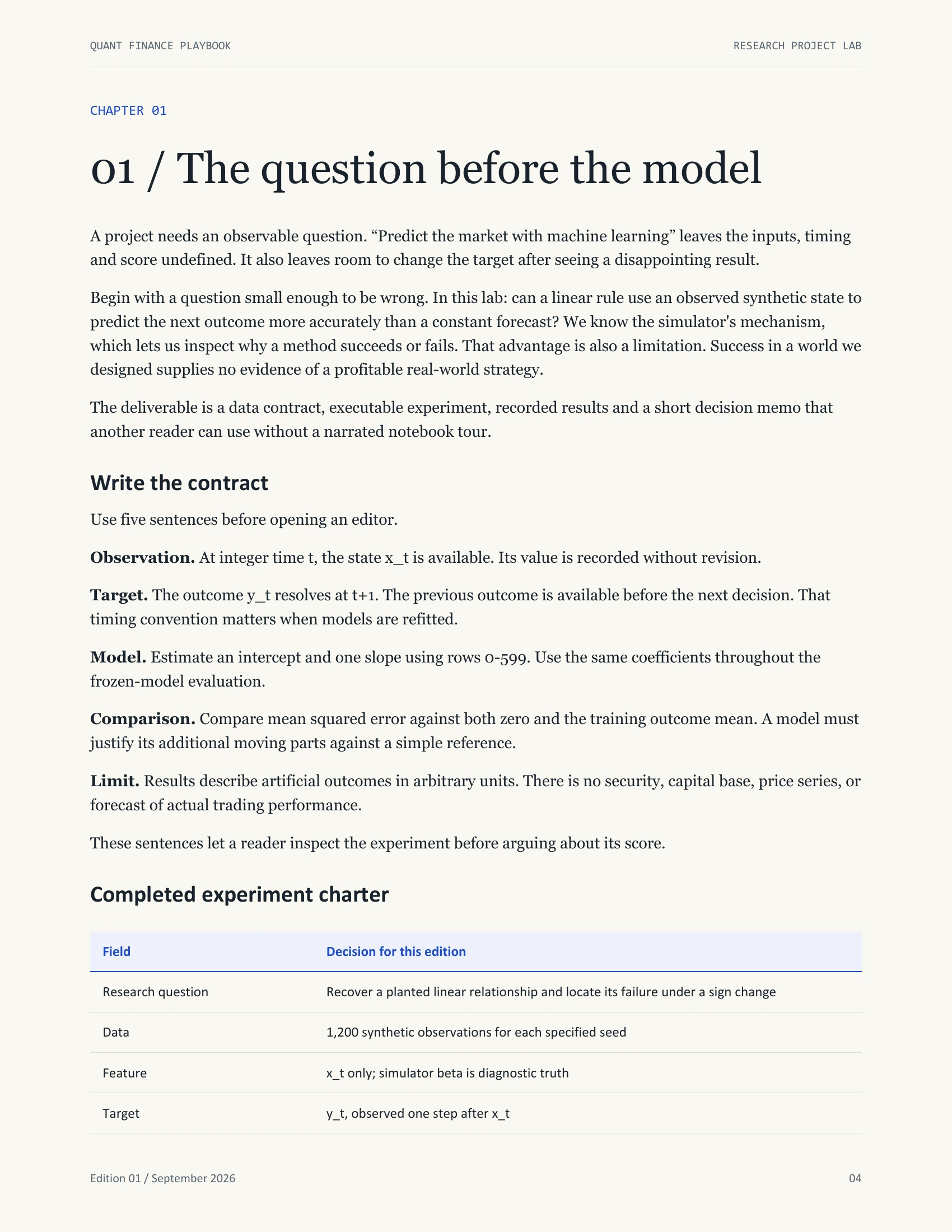
Open the PDF previewPreview page 4 of 7. Use Enlarge page for a closer view. When the page is focused, use left and right arrows to change pages.