Choose a question before choosing a model. A useful project has an observable target, inputs available at the stated decision time, a comparison and a deliverable another reader can inspect.
“Build a profitable strategy with several advanced models” leaves too many decisions open. It also invites you to change the goal whenever a result disappoints.
Three bounded project directions
Recover a known signal. Use a synthetic generator, fit a simple forecast and compare it with a constant. Explain what the simulator makes easy and why success does not establish a market opportunity.
Audit information timing. Define a multi-step target and identify which labels have resolved at each fitting boundary. Compare a valid rule with an intentionally invalid diagnostic, clearly labeled.
Build a research-data interface. Specify timestamps, accepted inputs and failure behavior. Demonstrate how a consumer distinguishes complete data from a partial result. Add prediction only if it answers a relevant question.
These directions suit different evidence gaps. Pick the one most connected to your target responsibilities and existing skills.
Write a one-page charter
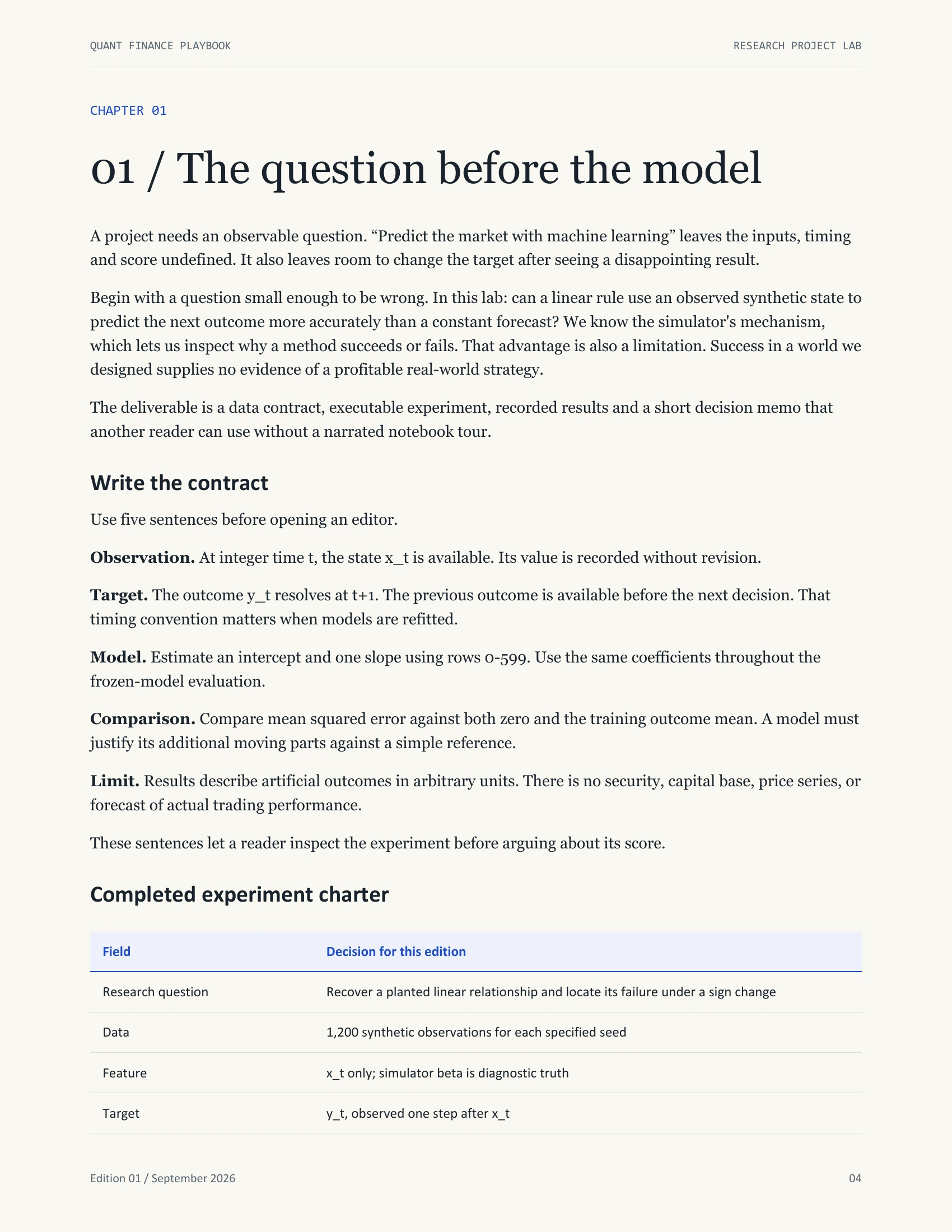
State the question, input availability, target, baseline, metric, fitting and evaluation rows, expected artifact and claim boundary. Add the result that would change your mind.
For an original synthetic example: “Does a current observed state improve next-step squared prediction error against the training mean? Fit early rows, evaluate later rows and retain the failure after a planted sign change.”
This is precise enough to investigate. It does not require the model to win before the project can be useful.
Inspect data constraints early
Publicly visible data is not automatically licensed for redistribution. Historical values may have been revised. A period-end date may differ from publication time. A dataset assembled today may omit entities that disappeared.
If you cannot support the intended information contract, narrow the claim or use synthetic data to study the method. State what that substitute cannot establish.
Finish the explanation
Keep a reproduction command, unrounded results, trial log and short memo. Include a failure case. A dashboard can help inspect the work, but it should not replace the procedure or become the main task before the experiment is sound.
The stopping condition is that another reader can identify the question, reproduce the central comparison and explain the limitation. That is a better boundary than “add one more model.”
The Quant Research Project Lab supplies one complete synthetic starting point. Read the README guide before preparing a portfolio release.
For an implementation-level view before choosing the lab, inspect the Python research-project preparation page. It explains the standard-library workflow, baseline comparison and limits of the synthetic study.
Read before choosing
Open the actual pages.
7 sample pages, including complete explanations. No email address or account required.
Open the PDF previewPreview page 4 of 7. Use Enlarge page for a closer view. When the page is focused, use left and right arrows to change pages.